LGBTQIAP+ Experiences of Expulsion: Reflections on Family, Violence, and Temporalities in the Brazilian Context
Venue
Violet Laidlaw Room, Chrystal Macmillan BuildingMedia
Image
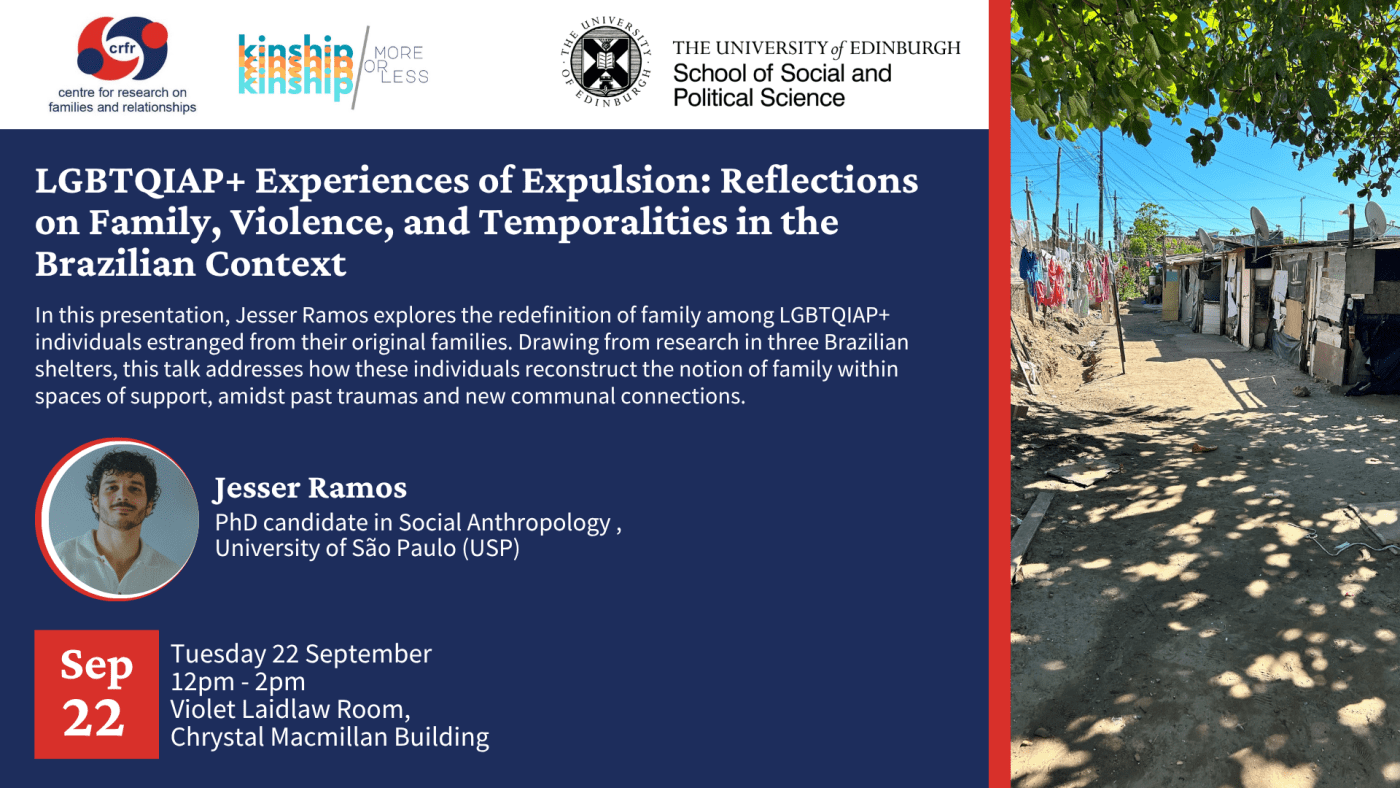
Description
This event is co-organised by CRFR and the Kinship Hub and will be chaired by Siobhan Magee.
Click here to register via Eventbrite.
Abstract
In this presentation, I aim to explore the meanings and forms through which the notion of family emerges in the narratives of LGBTQIAP+ individuals expelled from their families of origin. This work is grounded in my doctoral research, conducted in three shelters located across different Brazilian regions: Casa 1 (São Paulo), CasAmor Neide Silva (Aracaju), and Casa Miga (Manaus), which serve as vital support spaces for vulnerabilized subjects. Drawing on the stories of expulsion shared by the residents, the first part of the presentation examines how the family home is permeated by images of violence, suppression, and silencing. In these accounts, the family emerges simultaneously as the locus and the agent of violations against queer existences, materializing in memories marked by the unbreathable and the unbearable. In the second part, I analyze how family acquires different conceptions based on the lived present and the imagined future within these shelter contexts. I demonstrate how, in these new settings, home and family cease to be restricted to familial violence, coming instead to be understood through diverse affective arrangements and forms of political struggle, which constitute, for LGBTQIAP+ individuals, fundamental modes of persistence and the continuity of existence.
Short bio
Jesser Ramos is a PhD candidate in Social Anthropology at the University of São Paulo (USP) and a member of the HYBRIS (USP/UFSCar) and Metis research groups. His research explores shelters for LGBTQIAP+ individuals, with interests intersecting politics, memory, kinship, gender, and territory. His doctoral work offers a comparative analysis of Casa 1 (São Paulo), CasAmor Neide Silva (Aracaju), and Casa Miga (Manaus), examining the distinct modes of territorialization and institutional operation within these spaces.