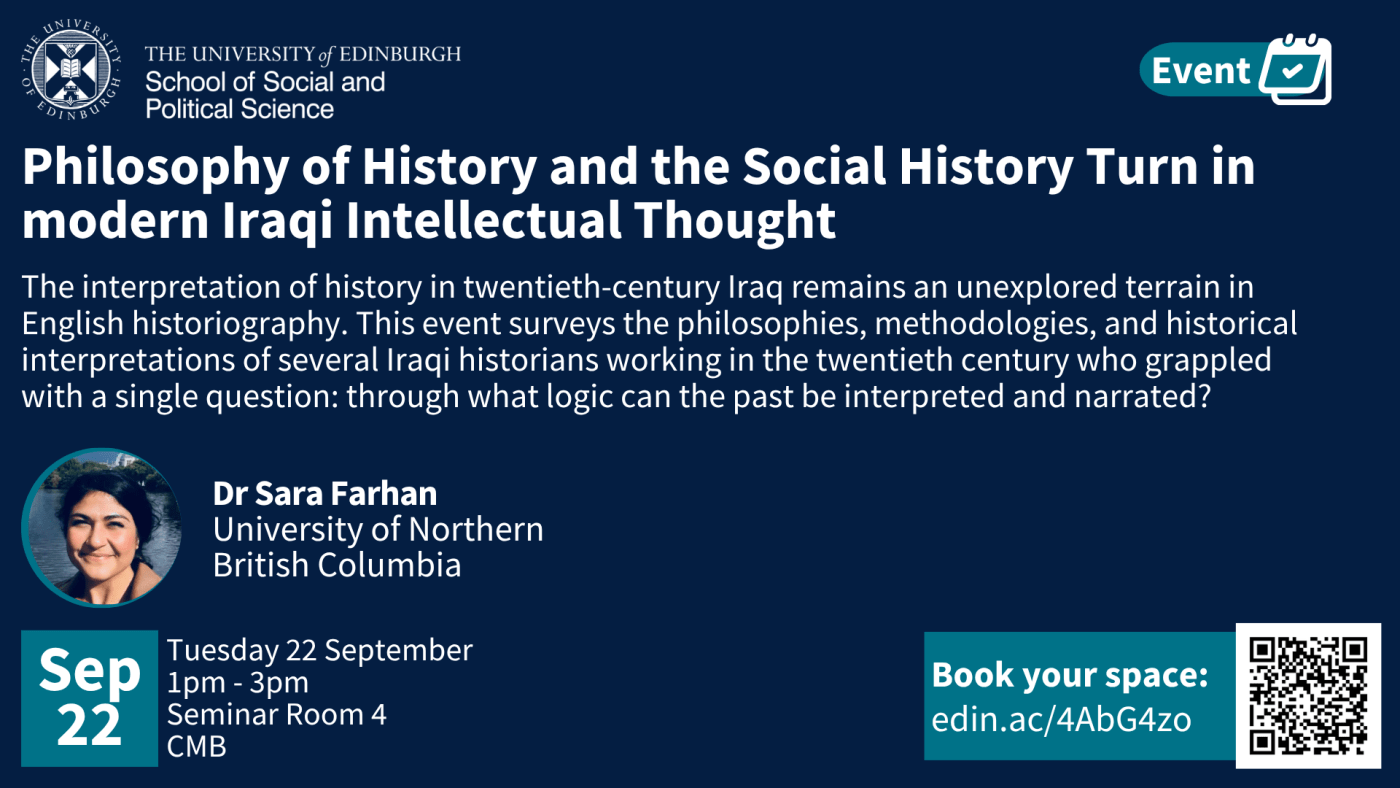
Philosophy of History and the Social History Turn in modern Iraqi Intellectual Thought
Venue
Seminar Room 4, CMBMedia
Image
Description
The interpretation of history in twentieth-century Iraq remains an unexplored terrain in English historiography. This paper surveys the philosophies, methodologies, and historical interpretations of several Iraqi historians working in the twentieth century who grappled with a single question: through what logic can the past be interpreted and narrated? Be it through Marxist structuralism of dialectical and historical materialism, civilizational analyses, progressive-nationalist structuralism, or pluralistic methodologies drawn from Islamic historical criticism, this paper contends that Iraqi historians shared a common refusal of dogmatic historical narration and promoted a ‘living history’ approach that called for the understanding of the past ‘with a spirit of criticism’ that does not sacrifice ‘its facts on the altar of skeptical doubt’ (Al-Duri, 1979). Marxist historians like Amer Abdullah (Comrade Karram) and Hadi al-Alawi championed class struggle, dialectics, and materialist causation as historically specific and non-mechanical categories of analysis while rejecting civilizational framings or stage-theories to understand the past. Other historians, most notably Aziz al-Duri, instead emphasized civilizational development through Khaldunian frameworks to analyze land tenure, taxation, and labour and trade. Similarly, in their criticism of 'imported foreign schema’ of historical interpretation (Abdullah, 1969), some warned against romanticizing history into a series of stages and rejected the uncritical application of Eurocentric models. And yet, proponents of cyclical history perceived Marxist structuralism as a Eurocentric methodology. Nonetheless, and collectively, these historians shared a commitment to interdisciplinarity by drawing upon economic, philosophical, sociological, and scientific approaches to analyze historiography and narrate history. Iraqi historiography in the twentieth century, therefore, constituted an epistemological enterprise that was preoccupied with the philosophy of history, its kaleidoscopic interpretations, and the interdisciplinary methodologies required for the historian’s craft.
Sara Farhan is a cultural and social historian of the modern Middle East, specializing in the histories of medicine, professionalization, and education. Her research explores how colonial legacies, state-building projects, and social hierarchies have shaped institutional and intellectual developments in the region. She approaches these questions through an interdisciplinary lens, drawing on the intersections of medical history, legal history, and archival studies.’